Table of Contents
- Why Vietnamese SMEs Should Sell on Alibaba in 2024
- Step 1: Setting Up Your Alibaba Supplier Account
- Step 2: Choosing the Right Membership Plan
- Step 3: Building a High-Converting Storefront
- Step 4: Creating Product Listings That Rank and Convert
- Step 5: Alibaba SEO and Keyword Strategy
- Step 6: Trade Assurance and Building Buyer Trust
- Step 7: RFQ — Responding to Buyer Requests Effectively
- Step 8: Pricing Strategy for International Buyers
- Step 9: Alibaba Messaging — How to Convert Inquiries to Orders
- Step 10: Logistics and Export Documentation
- Step 11: Using Alibaba Data Insights to Grow
- Real Case Studies: Vietnamese SMEs on Alibaba
- Top 7 Mistakes Vietnamese Sellers Make on Alibaba
- FAQ
Why Vietnamese SMEs Should Sell on Alibaba in 2024
Vietnam’s export economy is uniquely positioned for Alibaba. We manufacture everything international buyers are actively searching for: ceramics, garments, agricultural products, natural cosmetics, furniture, electronics components. The supply side is strong. The gap — and where most Vietnamese businesses leave money on the table — is on the demand-capture side.
Alibaba puts Vietnamese suppliers in front of wholesale buyers, distributors, and brand owners from the US, EU, Middle East, Korea, Japan, and Australia. These are buyers with serious purchasing intent, not casual browsers.
Key Stats Vietnamese Exporters Need to Know
| Metric | Number |
|---|---|
| Active buyers on Alibaba globally | 40+ million |
| Countries with Alibaba buyer presence | 190+ |
| Annual GMV (Alibaba International) | USD ~$50B+ |
| Top buyer markets for Vietnamese goods | US, UK, Australia, Germany, UAE |
| Average response time expectation from buyers | Under 24 hours |
The platform is not passive income. Vietnamese suppliers who succeed on Alibaba treat it like a sales operation — not a listing board. That distinction is everything.
What Products Sell Well from Vietnam on Alibaba?
- Handcrafted goods: Ceramics, lacquerware, rattan, bamboo furniture
- Garments and textiles: OEM menswear, activewear, uniforms
- Agricultural exports: Durian, cashews, pepper, coffee, rice
- Natural and organic cosmetics: Coconut-based skincare, herbal products
- Electronics and components: Wire harnesses, PCBs, LED products
- Footwear: OEM/ODM sneakers and leather shoes
If your product is manufactured in Vietnam and has export potential, Alibaba has a buyer segment for it. Your job is to show up correctly.
Step 1: Setting Up Your Alibaba Supplier Account
The setup phase determines your credibility ceiling. Buyers vet suppliers quickly — they make snap judgments based on your profile completeness, certifications, and company images. Get this foundation right before you spend a single dollar on traffic.
What You Need Before Registering
- Business registration certificate (Giấy chứng nhận đăng ký doanh nghiệp)
- Business email address (not Gmail — use your company domain)
- Company logo in high resolution (PNG, transparent background)
- Factory or warehouse photos — real photos, not stock images
- Product photos (we’ll cover standards in Step 4)
- Export license if applicable to your product category
Account Registration Process
- Go to seller.alibaba.com and click “Start Selling”
- Enter your business email and set a strong password
- Select “Supplier” as your account type
- Input your company name exactly as it appears on your business certificate
- Select your main product category — be precise, this affects search placement
- Verify your email and complete basic identity verification
Company Profile — Don’t Rush This
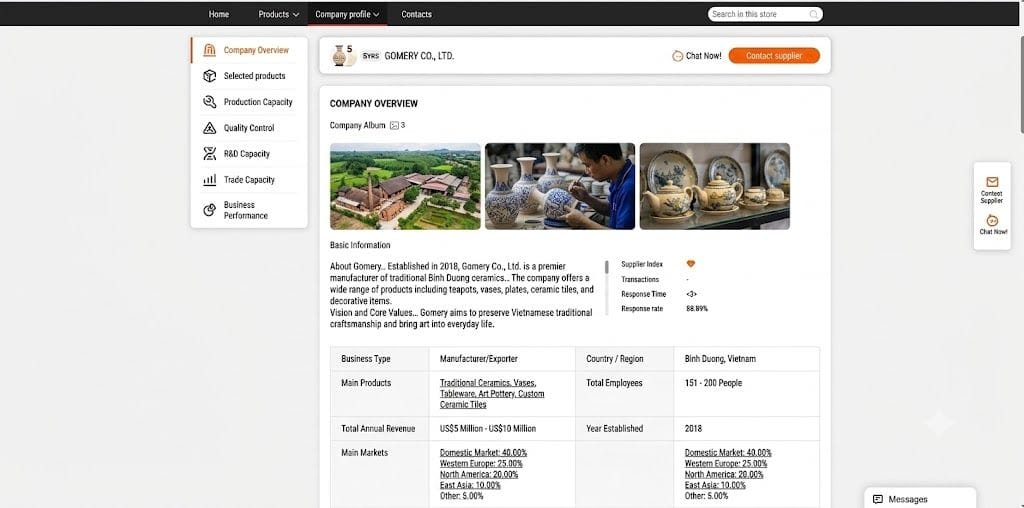
Your company profile is your first sales page. Every buyer who finds your product will click to your profile before they send an inquiry. At Big E, we spend a full working day on client profiles before we touch product listings. Here’s what the profile section must include:
- Company description: Write in English. Tell the story of your manufacturing capacity, years in business, key markets you already serve. Be specific — “We’ve exported to 12 countries” beats “We are an international company.”
- Factory photos: Show production lines, quality control stations, warehouse. 8–12 photos minimum.
- Certifications: ISO, BSCI, OEKO-TEX, FDA, organic — upload everything you have. Even Vietnamese HACCP or VietGAP certificates signal seriousness.
- Trade capacity: Fill in annual revenue, number of employees, production capacity per month.
- Main markets: Select all countries you currently export to or target.
Step 2: Choosing the Right Membership Plan
This is where most Vietnamese suppliers get confused — or get oversold. Let me break it down clearly.
Free vs. Paid Membership
| Feature | Free Account | Gold Supplier (Paid) |
|---|---|---|
| Product listings allowed | Up to 50 | Up to unlimited (plan-dependent) |
| Verified supplier badge | No | Yes |
| Trade Assurance eligibility | Limited | Full access |
| Keyword advertising access | No | Yes |
| Response rate tracking | Basic | Full analytics |
| Annual cost (approximate) | Free | USD $2,000–$10,000/year |
My Recommendation for Vietnamese SMEs
If your monthly export revenue target is under $20,000, start with a free account, optimize your listings, and prove the channel works before upgrading. If you’re serious about Alibaba as a primary export channel and you have 20+ SKUs to list, the Gold Supplier membership pays for itself within 2–3 closed orders for most product categories.
The Gold Supplier badge is a trust signal buyers actually look for. In our experience with clients like the Ben Tre Coconut Cosmetics team, the badge alone improved inquiry conversion rate noticeably — buyers filter by verified suppliers constantly.
Onboarding Assessment Package
Alibaba also offers a onboarding assessment (sometimes called “Verified Supplier” audit) through third-party agencies. This is separate from Gold membership. If your competitors have it and you don’t, you’re at a disadvantage in trust-sensitive categories like food, cosmetics, and children’s products.
Step 3: Building a High-Converting Storefront
Your Alibaba storefront is your international showroom. Think of it as a micro-website hosted within Alibaba’s ecosystem. Buyers land here, evaluate your brand, browse your range, and decide whether to send an inquiry or bounce.
Storefront Design Principles
- Brand banner: Custom designed, not the default template. Show your factory, your hero product, your key value proposition. “20 Years Manufacturing | MOQ 50 Units | OEM Welcome” — something concrete.
- Product categories: Organize logically. Buyers who land looking for one product should be able to discover adjacent products easily.
- Featured products: Pin your 3–5 bestsellers or highest-margin SKUs to the top.
- Company introduction video: A 60–90 second factory walkthrough video increases inquiry rate significantly. We’ve seen it boost engagement by 30–40% for clients.
- Contact information: Make it visible. Don’t bury your WhatsApp, WeChat, or email deep in the profile.
Storefront Checklist Before Going Live
- ✅ Custom banner designed (1920×600px recommended)
- ✅ Company intro video uploaded
- ✅ Minimum 10 product listings published
- ✅ All certification documents uploaded
- ✅ Trade Assurance activated
- ✅ Response time set up (auto-reply for out-of-hours)
- ✅ Main markets and product categories selected accurately
Step 4: Creating Product Listings That Rank and Convert
This is where 80% of Vietnamese suppliers fail. They upload photos, write a product name in broken English, list a price range, and wonder why inquiries never come. A listing is not a product card — it’s a sales argument.
Product Title Formula
Alibaba’s search algorithm weighs your product title heavily. Use this structure:
[Material/Method] + [Product Name] + [Key Specification] + [Use Case or Buyer Type] + [Origin or Certification]
Examples:
- ❌ Bad: “Vietnam ceramic bowl”
- ✅ Good: “Handmade Stoneware Ceramic Bowl 500ml | OEM Custom Color | Vietnam Artisan Factory Export”
- ❌ Bad: “Men shirt”
- ✅ Good: “OEM Men’s Cotton Linen Dress Shirt | MOQ 100pcs | Custom Label | Vietnam Garment Manufacturer”
Product Photos — Non-Negotiable Standards
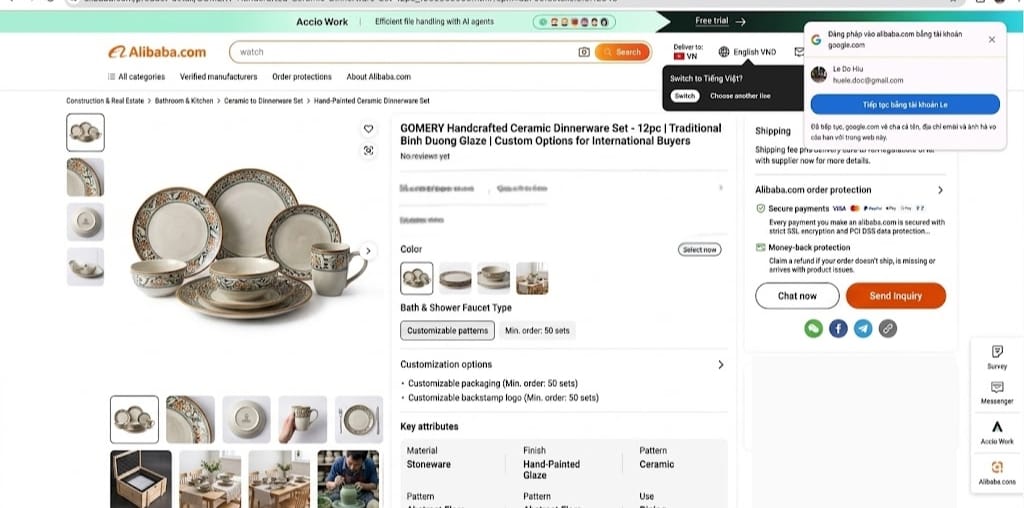
Buyers from the US, EU, and Australia are comparing your product photos against Chinese suppliers who invest heavily in photography. You must compete visually.
- Minimum 6 images per product, ideally 8–10
- Main image: white background, product centered, full frame
- Detail shots: texture, stitching, clay grain, wood grain — whatever makes your product special
- Scale reference photo: show the product next to a hand or common object
- Lifestyle or in-use shot: product in a real environment
- Packaging shot: how the product ships — buyers care about this
- Certifications or label close-up if relevant
Product Description Structure
Write your descriptions for a buyer who is evaluating 20 suppliers simultaneously. Answer their questions before they ask.
- Product overview (2–3 sentences): What it is, what it’s made from, who it’s for
- Key specifications table: Material, dimensions, weight, color options, MOQ, lead time
- Manufacturing process: Brief description of how it’s made — this builds credibility
- Customization options: OEM/ODM capability, logo printing, color matching, private label
- Quality control: Testing standards, inspection process, certifications
- Packaging and shipping: Inner box, carton dimensions, how you handle export
- Why choose us: Factory history, key export markets, client types you serve
Specifications Table Example (Ceramics)
| Specification | Details |
|---|---|
| Material | High-fired stoneware clay, food-safe glaze |
| Capacity | 350ml / 500ml / 750ml (customizable) |
| Dimensions | H: 10cm | D: 12cm (±5%) |
| Weight | 320g per piece |
| MOQ | 50 pieces per design |
| Lead Time | 25–35 days for custom orders |
| Certifications | FDA food-safe, California Prop 65 compliant |
| Packaging | Individual foam wrap + kraft box |
Step 5: Alibaba SEO and Keyword Strategy
Most Vietnamese sellers on Alibaba have zero keyword strategy. They write product titles in Vietnamese-influenced English and wonder why they don’t appear in search results. This section is where the real competitive advantage lives.
How Alibaba Search Works
Alibaba’s search algorithm ranks products based on:
- Keyword relevance: Title, keywords field, description text
- Supplier quality score: Response rate, transaction history, reviews
- Listing completeness: How fully you’ve filled out all fields
- Engagement signals: Click-through rate, inquiry rate
- Trade Assurance status: Verified suppliers get algorithmic preference
Keyword Research Process
Start with Alibaba’s own search bar. Type your product category and look at the autocomplete suggestions — those are real buyer search terms. Also use:
- Alibaba’s “Hot Keywords” dashboard in your seller console
- Google Keyword Planner for global search volume validation
- Competitor reverse engineering: Find top-ranking suppliers in your category, analyze their titles and descriptions
Keyword Placement Strategy
- Product title: Primary keyword + 2 secondary keywords (under 200 characters)
- Keywords field: Fill all available keyword slots — use synonyms, alternate spellings, application-based terms
- Description: Use keywords naturally in the first 150 words and at least 3–4 more times throughout
- Category selection: Choose the most specific category, not the broadest
Real Keyword Examples by Industry
| Product | Weak Keyword | Strong Keyword |
|---|---|---|
| Ceramics | Vietnam ceramic | handmade stoneware bowl wholesale Vietnam artisan |
| Menswear | men shirt Vietnam | OEM men’s dress shirt custom label MOQ 100 Vietnam factory |
| Durian | fresh durian | frozen durian pulp bulk export Vietnam Monthong Grade A |
| Coconut cosmetics | coconut cream | organic coconut body lotion private label Vietnam OEM |
When I worked with the Tien Giang Durian team after meeting owner Van at the Vietnam Agricultural Festival in Vinh Long 2023, the first thing we did was tear apart their keyword approach. They were using “durian Vietnam” as their primary keyword — extremely broad, dominated by large exporters. We shifted to long-tail, buyer-intent terms like “frozen durian pulp wholesale export” and “Monthong durian Grade A bulk.” Inquiry quality improved dramatically within 60 days.
Step 6: Trade Assurance and Building Buyer Trust
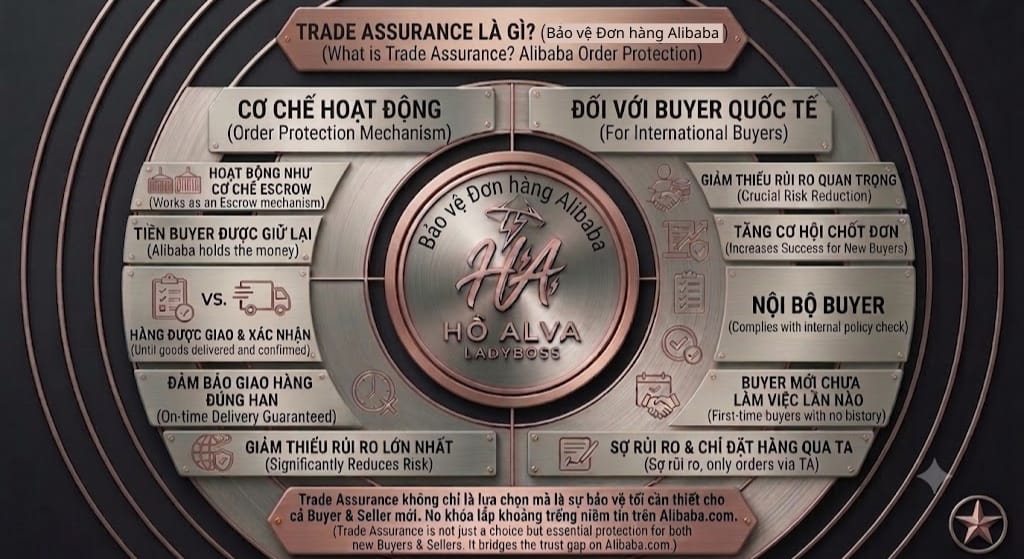
Trade Assurance is Alibaba’s built-in buyer protection program. When you offer Trade Assurance, Alibaba guarantees the buyer’s payment if you fail to deliver on time or if product quality doesn’t match the order agreement. For buyers — especially first-time buyers testing a new supplier — this is a massive risk reducer.
Why This Matters for Vietnamese Sellers
Vietnamese suppliers are competing against Chinese factories with 10+ years of Alibaba transaction history and thousands of reviews. For a new Vietnamese supplier, Trade Assurance is one of the fastest ways to level the trust gap.
How to Activate Trade Assurance
- Go to your seller dashboard → Trade Assurance section
- Link a bank account (must be in your company name)
- Set your maximum coverage amount
- Complete identity verification if prompted
- Enable Trade Assurance on individual product listings
Other Trust Signals to Stack
- Response Rate: Aim for 95%+ response rate. Alibaba displays this publicly. Buyers filter suppliers by it.
- On-time delivery rate: Keep above 90%. Even one late shipment hurts your metrics.
- Reviews and ratings: After every successful order, follow up and request a review. Don’t assume buyers will leave one automatically.
- Verified Supplier badge: Requires a third-party audit of your factory. Worth the investment for manufacturing clients.
Step 7: RFQ — Responding to Buyer Requests Effectively
The RFQ (Request for Quotation) marketplace is one of Alibaba’s most underused features by Vietnamese suppliers. Every day, thousands of buyers post sourcing requests describing exactly what they want to buy. You can browse these and submit quotes proactively.
Finding Relevant RFQs
- Go to the RFQ Marketplace in your seller dashboard
- Filter by product category, country of buyer, and order quantity
- Focus on RFQs posted within the last 24–48 hours for best response rate
How to Write a Winning RFQ Response
The average Vietnamese supplier submits a lazy RFQ response: “Dear sir, we can supply. Please share more details.” This does not win business.
A strong RFQ response should:
- Address the buyer’s specific requirement — reference their exact language
- Confirm whether you can meet MOQ and lead time
- Provide a preliminary unit price range with conditions (EXW or FOB)
- Mention one relevant credential (years of export experience, relevant certification)
- End with a clear next step (“I can send a formal quotation within 24 hours. Could you confirm the port of delivery?”).
RFQ Response Template
“Dear [Name], Thank you for your inquiry on [product]. We manufacture [specific product type] at our factory in [location, Vietnam]. We can meet your requirement of [quantity] with a lead time of [X] days. Our FOB price for this specification is approximately USD [range] per unit at MOQ [quantity]. We hold [relevant certification] and currently export to [key markets]. I’m attaching our product catalog and can arrange samples within [X] days. What is your target delivery port? Looking forward to working with you.”
Step 8: Pricing Strategy for International Buyers
Pricing on Alibaba is both a competitive tool and a trust signal. Price too low and buyers assume quality issues. Price without a clear structure and you’ll lose deals you could have won.
Understanding Incoterms for Alibaba Pricing
| Term | What It Means | When to Use |
|---|---|---|
| EXW (Ex Works) | Buyer collects from your factory | When buyer has their own freight forwarder |
| FOB (Free on Board) | You deliver to port, buyer takes over | Most common for Vietnamese exporters |
| CIF (Cost Insurance Freight) | You cover shipping + insurance to destination port | When buyers want a simpler total cost |
| DDP (Delivered Duty Paid) | You handle everything to buyer’s door | Premium service, high-margin situations |
For most Vietnamese SMEs, FOB pricing is the sweet spot. You control your manufacturing costs and local logistics, and the international freight risk transfers to the buyer at the port.
Tiered Pricing Structure
Display tiered pricing in your listings. Alibaba has a price tier table built into the listing form. Use it. Buyers see the volume discount and it incentivizes larger orders.
- 50–200 units: $X.XX per unit
- 201–500 units: $X.XX per unit (–8%)
- 501–1000 units: $X.XX per unit (–15%)
- 1000+ units: Contact for quote
Never List a “Too Good” Price
One mistake we saw frequently with new clients: they underpriced to get first orders, then couldn’t sustain the margin. Set your floor price realistically. International buyers expect to negotiate, but they also know that razor-thin pricing often means quality compromise. Price with confidence in your craft.
Step 9: Alibaba Messaging — How to Convert Inquiries to Orders
An inquiry is not a sale. The gap between “received inquiry” and “closed order” is where most Vietnamese suppliers leak revenue. Here’s how to close that gap.
The First Reply is Everything
Data from Alibaba’s platform shows that suppliers who respond within 1 hour have significantly higher conversion rates than those who respond within 24 hours. Set up notifications on your phone. If you’re in a different time zone than your buyer (which you often are), use Alibaba’s auto-reply to acknowledge receipt and set expectations.
First Reply Structure
- Greet by name (check the buyer’s profile)
- Confirm you understand their requirement
- Provide the 3 most important data points: price, MOQ, lead time
- Ask 1–2 qualifying questions to move the conversation forward
- Attach your product catalog or specification sheet
Common Inquiry Types and How to Handle Them
| Inquiry Type | What Buyer Wants | Your Response Priority |
|---|---|---|
| Price inquiry | Ballpark cost for budgeting | Give FOB price range, ask for order quantity |
| Sample request | Physical product evaluation | Confirm sample cost and lead time immediately |
| OEM inquiry | Custom product manufacturing | Ask for spec sheet, artwork, target price |
| MOQ negotiation | Order quantity below your stated MOQ | Evaluate case by case — first orders often merit flexibility |
| Certification request | Compliance verification | Send documents same day — no delays here |
Language and Communication Standards
English quality in your messages matters. One of the services we provide at Big E is communication templates and training for client teams. A message with grammar errors signals unprofessionalism to European and American buyers. If your team’s English is limited, invest in a communication template library — standard responses for the 20 most common inquiry types, pre-approved and grammatically correct.
Step 10: Logistics and Export Documentation
The product side of Alibaba is only half the equation. Getting goods from your factory in Vietnam to a buyer’s warehouse in Germany or California requires logistics competency. Buyers ask about this. Have clear answers.
Common Export Documents Vietnamese Suppliers Need
- Commercial Invoice: Value and description of goods
- Packing List: Detailed contents, weights, dimensions per carton
- Bill of Lading (B/L): Shipping document from freight forwarder
- Certificate of Origin (C/O): Required for tariff preferences (Form D for ASEAN, Form B for others)
- Phytosanitary Certificate: Required for agricultural exports
- Health Certificate: For food and cosmetic products
- Export License: For controlled goods (certain agricultural products, chemicals)
Choosing a Freight Forwarder
Work with a licensed freight forwarder experienced in Vietnamese export. Key ports for Vietnamese exporters:
- Ho Chi Minh City: Cat Lai Port (Tan Cang) — main southern export hub
- Hanoi/North Vietnam: Hai Phong Port
- Air freight: Tan Son Nhat (SGN), Noi Bai (HAN) for high-value, time-sensitive goods
Communicating Lead Times Accurately
Under-promise and over-deliver on lead times. If production takes 25 days and shipping takes 20 days, tell buyers 50 days total (with buffer). Missing your stated delivery window damages your Trade Assurance rating and your reputation.
Step 11: Using Alibaba Data Insights to Grow
Alibaba gives you a seller analytics dashboard with data most Vietnamese suppliers never look at. This is your competitive intelligence tool.
Key Metrics to Monitor Weekly
- Product impressions: How many times your listing appeared in search
- Click-through rate (CTR): % of impressions that became clicks — low CTR means your main photo or title needs work
- Inquiry rate: % of product page visits that converted to inquiries — low inquiry rate means your description or price is not convincing
- Response rate and response time: Platform visible to buyers, directly affects ranking
- Keyword performance: Which search terms are driving traffic to your listings
Monthly Review Process
- Identify your top 5 performing listings by inquiry rate — replicate what works
- Identify your bottom 5 — rewrite titles, replace main photos, add keywords
- Check your competitor benchmark in the analytics panel — Alibaba shows industry average metrics
- Review incoming RFQs — are there patterns in what buyers are requesting that you don’t yet list?
- Adjust pricing if competitor pricing has shifted significantly
Real Case Studies: Vietnamese SMEs on Alibaba
Case Study 1: Gomery Ceramics — Binh Duong
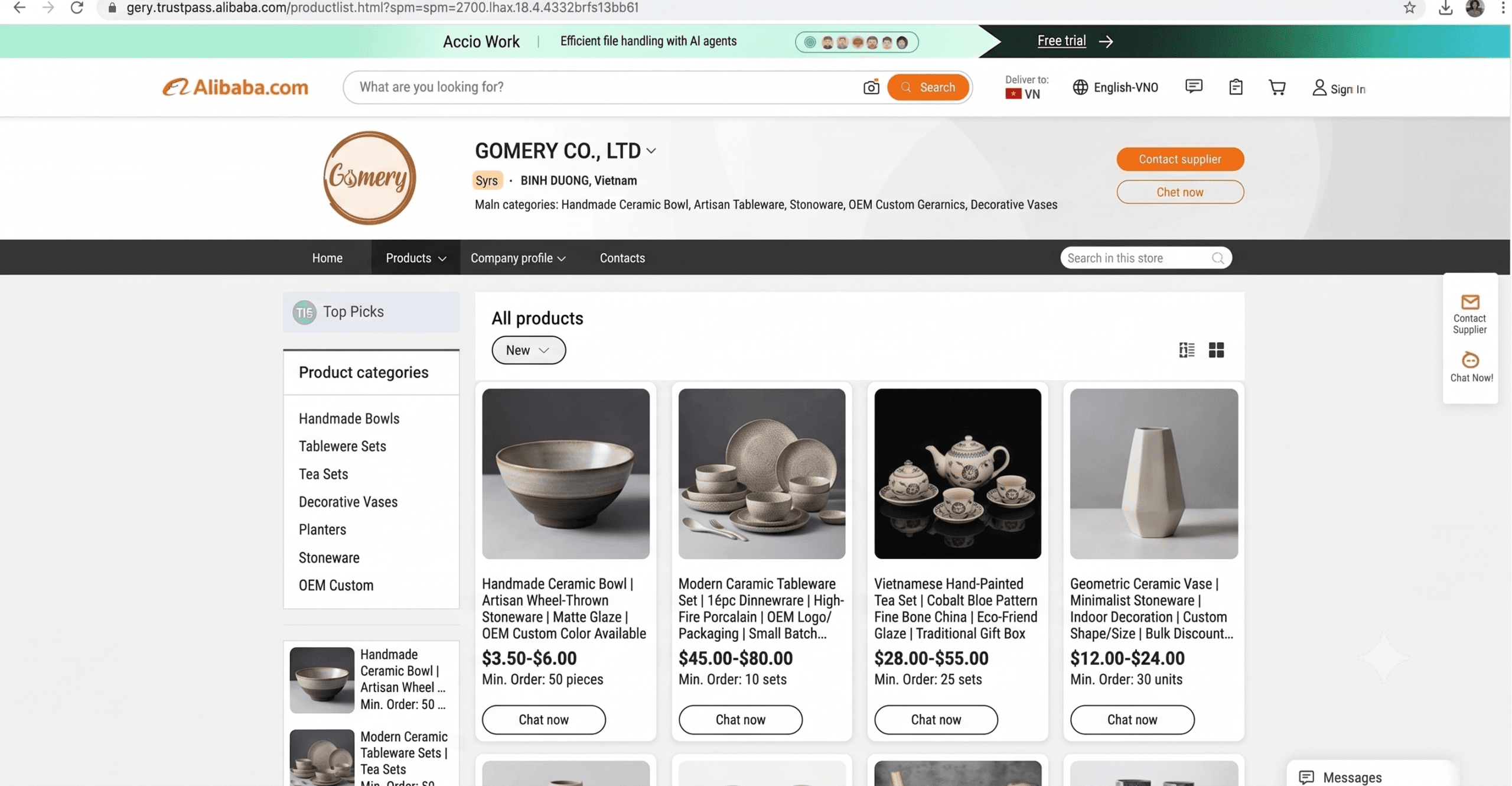
Sisters Ha and Anh run Gomery, a hand-thrown ceramics studio in Binh Duong producing genuinely one-of-a-kind pieces. When they came to Big E, they had a beautiful product and zero international presence. Their English product descriptions were minimal, their photos were shot on a phone with a tiled floor background, and they had no keyword strategy.
We built their Alibaba storefront from scratch alongside their Etsy presence, targeting wholesale buyers in Hong Kong and Taiwan — markets with strong appetite for artisan ceramic tableware and a cultural appreciation for Vietnamese craft.
What we did:
- Professional photography session — white background + lifestyle shots in a styled café setting
- Rewrote all product titles and descriptions with buyer-intent keywords
- Created a Gold Supplier profile with full factory documentation
- Activated Trade Assurance
- Built a tiered pricing structure from MOQ 50 pieces
Results:
- 📈 +202% revenue increase within the first year
- 📈 +160% qualified leads from international buyers
- Key markets achieved: Hong Kong, Taiwan, Singapore
The lesson here: product quality was never the problem. Visibility and trust signals were. Once we fixed the presentation layer, the orders followed.
Case Study 2: Tien Giang Durian — Agricultural Export
I met owner Van at the Vietnam Agricultural Festival in Vinh Long 2023. He had a strong supply chain — Ri6 and Monthong durian from Tien Giang province, good quality control, and existing domestic distribution. International, though? Nothing.
The challenge with agricultural products on Alibaba is fierce competition from Thai suppliers who have dominated the durian export narrative globally. We needed to differentiate on specificity.
What we did:
- Shifted from generic keywords (“durian Vietnam”) to hyper-specific terms: “frozen durian pulp bulk Grade A Monthong Vietnam FOB”
- Created listings in both fresh and processed durian categories with separate, detailed specs
- Built a compliance documentation section showcasing phytosanitary certificates and cold chain capability
- Optimized English descriptions for international cold-chain buyers specifically
Within 60 days of launching optimized listings, Van’s team started receiving inquiries from Middle East importers and a Korean distributor — markets Van had never accessed before. The keyword shift from broad to buyer-intent was the single biggest lever.
Case Study 3: Ben Tre Coconut Cosmetics — Natural Beauty Export
The Ben Tre Coconut Cosmetics client had a compelling product story: natural, organic-positioned skincare made from Ben Tre coconut derivatives — coconut oil, coconut water, coconut shell extract. The Vietnamese domestic market was strong, but international was the opportunity.
Natural cosmetics is a high-competition space on Alibaba. Korean and Chinese suppliers dominate the search results for most generic beauty terms. Our strategy was to lean into the geographic origin story and OEM/private label positioning.
What we did:
- Repositioned listings around “Vietnam organic coconut cosmetics OEM” and “private label coconut skincare Vietnam factory”
- Created an OEM capability showcase page within the storefront
- Uploaded MSDS sheets, FDA registration, and ISO documentation prominently
- Added before/after product photos and raw ingredient sourcing narrative in descriptions
The OEM angle attracted beauty brand buyers from Australia and Germany who wanted a differentiated supply story — “made with authentic Vietnamese coconut” was a unique selling point their end consumers could appreciate. The key was translating that story into the language international buyers search with.
Top 7 Mistakes Vietnamese Sellers Make on Alibaba
After reviewing hundreds of Vietnamese supplier profiles over 5 years, these mistakes come up again and again.
Mistake 1: English That Loses Buyer Trust
Machine-translated product descriptions full of grammatical errors are an immediate red flag for buyers. Invest in having a native English speaker or professional translator review all buyer-facing copy. This is not optional if you’re targeting US, UK, or Australian buyers.
Mistake 2: Photos That Look Unprofessional
Blurry photos, dark backgrounds, cluttered backgrounds — these signal that the supplier doesn’t take presentation seriously. If you won’t invest in product photography, buyers assume you won’t invest in quality control either. Budget USD $200–500 for a proper photography session. It pays for itself in the first inquiry.
Mistake 3: Generic Product Titles
We’ve covered this — but it’s worth repeating because it’s so common. “Vietnam ceramic bowl” is not a product title. It’s a category description. Buyers search with intent. Match your title to buyer intent.
Mistake 4: Slow Response Time
The international buyer browsing Alibaba at 9am their time might be catching you at 3am Vietnam time. That’s reality. You have two options: use Alibaba’s auto-reply to acknowledge and set a 4-hour response window, or dedicate a team member to monitor messages across time zones. Either way, 24-hour response time is too slow for competitive categories.
Mistake 5: Ignoring the RFQ Marketplace
Vietnamese suppliers tend to be passive — they set up listings and wait. The RFQ marketplace rewards proactivity. Allocate 30 minutes daily to browsing and responding to relevant RFQs. This alone can generate 3–5 additional quality inquiries per week.
Mistake 6: Listing Incomplete Products
Empty specification fields, missing certifications, no MOQ stated, no lead time — incomplete listings rank lower in Alibaba search and convert worse when buyers land on them. Fill every field. Every empty field is a missed opportunity.
Mistake 7: Not Following Up After Samples
You send a sample. Buyer goes quiet. You assume they’re not interested. In reality, they may be evaluating your sample alongside three other suppliers and are waiting for internal approval. Follow up 5 days after sample delivery confirmation. Follow up again at 10 days. Persistence, done politely, closes orders.
Frequently Asked Questions: Selling on Alibaba as a Vietnamese Supplier
How much does it cost to sell on Alibaba from Vietnam?
A free account costs nothing to set up. The Gold Supplier (paid) membership ranges from approximately USD $2,000 to $10,000 per year depending on the plan tier and product category. There are also optional paid keyword advertising costs. Most SMEs should start with the free account to validate the channel before upgrading.
Do I need to speak English to sell on Alibaba?
Your product listings, storefront, and buyer communications must be in clear, professional English to access the US, EU, and Australian markets. You don’t need to be fluent personally, but you need to have someone handling communications who can write well in English. Many of our clients at Big E use pre-approved communication templates to manage this.
How long does it take to get first inquiries on Alibaba?
With a fully optimized storefront and listings, most clients start receiving inquiries within 2–4 weeks. Low-competition categories or very specific products can generate inquiries faster. Broad, highly competitive categories may take 60–90 days before your listing gains sufficient authority to appear prominently in search.
Can small manufacturers sell on Alibaba or is it only for large factories?
Small manufacturers can absolutely succeed on Alibaba. Gomery Ceramics — two sisters running a small studio — grew +202% in revenue through Alibaba. The platform serves everything from artisan producers to large factories. The key is matching your MOQ, lead time, and positioning to the buyer segment that fits your actual capacity. Don’t claim 10,000 unit production capacity if you’re a 500-unit workshop. Attract the right buyers for your real scale.
Is Alibaba better than Amazon for Vietnamese B2B exporters?
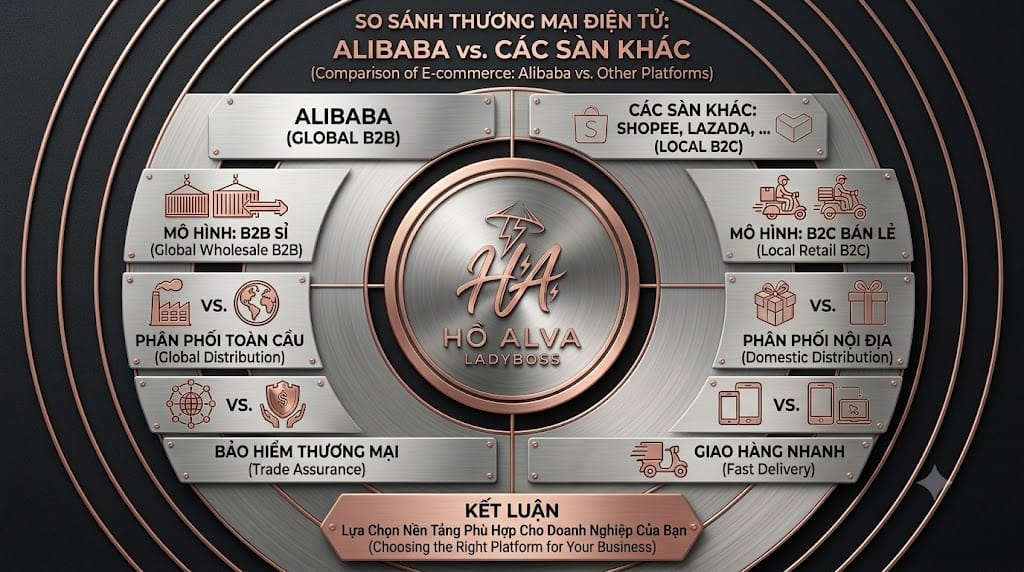
They serve different buyer types. Alibaba is a B2B wholesale marketplace — buyers are distributors, retailers, brand owners, procurement managers. Amazon (specifically Amazon Business or third-party selling) is primarily B2C retail. For Vietnamese manufacturers looking to sell in bulk to international buyers, Alibaba is generally the better starting point. Many of our clients run both channels in parallel for different product lines.
What certifications do Vietnamese suppliers need for Alibaba?
There’s no single required certification for Alibaba itself, but buyer requirements vary by product and target market. Food products targeting the US need FDA registration. Textiles going to Europe need OEKO-TEX or GOTS. Natural cosmetics need MSDS sheets. Upload every certification you have, even Vietnamese domestic ones — it signals a quality-minded operation. Then research the specific requirements of your target market’s product category.
How do I handle payments safely from international buyers?
Use Alibaba’s Trade Assurance for your first transactions with any buyer — it protects both parties and gives first-time buyers confidence. Once you’ve established a relationship with a buyer over 3–5 orders, you can negotiate payment terms directly (typically 30% deposit, 70% before shipment, or 30-day payment terms for established accounts). Never ship goods without a deposit or Trade Assurance order in place.
Can I list the same products on Alibaba and Etsy simultaneously?
Yes, and for artisan and handmade product categories, we often recommend it. Alibaba captures wholesale B2B buyers; Etsy captures individual retail buyers or small boutique owners. They don’t compete — they serve different purchase intents. Gomery runs both platforms and the combination was central to their +202% revenue growth.
Final Thoughts: Building a Sustainable Alibaba Export Business from Vietnam
Alibaba is not a passive income channel. It is a sales operation that requires consistent attention, optimization, and follow-through. The Vietnamese suppliers who succeed long-term on Alibaba treat it with the same seriousness they apply to their manufacturing operations.
The good news: Vietnamese SMEs have genuinely world-class products to offer. Ceramics with a story. Garments with craft. Agricultural goods with provenance. Natural cosmetics with authenticity. International buyers want what Vietnam makes. The gap is almost always in presentation, language, trust signals, and follow-up — not in product quality.
Close that gap systematically, using the framework in this guide, and Alibaba becomes one of your most powerful export growth engines.
At Big E Co., we’ve seen it work for ceramics sisters in Binh Duong, durian farmers in Tien Giang, menswear workshops in Tan Phu, and coconut beauty brands in Ben Tre. If your product has export potential, Alibaba has a buyer waiting to find it. Your job is to show up where they’re looking — with the right keywords, the right trust signals, and the right response speed.
Need help building or optimizing your Alibaba presence as a Vietnamese exporter? Contact Big E Co. — we’ve done this from zero to results, across industries, and we know the platform inside out.
Bạn muốn đồng hành cùng Hồ Alva?
Gia nhập cộng đồng Saigon Ladyboss — nơi những người phụ nữ bản lĩnh cùng nhau học và lớn lên.
Gia nhập Saigon Ladyboss →