I still remember the first listing I wrote for Gomery Ceramics back when I was hands-on managing the account. Bland title, generic description, three blurry photos — zero inquiries for two weeks. Once I rewrote it properly, the same product started pulling 5-7 inquiries a day. Learning how to write Alibaba product listing to attract international buyers isn’t about fancy words — it’s about structure, clarity, and speaking the buyer’s language. This guide is for Vietnamese SME exporters who want more qualified inquiries, not just more clicks. Let me walk you through exactly what I do.
Why Your Alibaba Listing Structure Matters More Than You Think
Knowing how to write an Alibaba product listing matters because B2B buyers scan a page in under 15 seconds before deciding whether to message you. Unlike Amazon shoppers browsing on emotion, Alibaba buyers are procurement managers or sourcing agents doing due diligence, so structure directly determines whether you get an inquiry.
Most sellers I coach think Alibaba buyers browse the way Amazon shoppers do — scrolling casually, deciding on emotion. That’s wrong. B2B buyers on Alibaba are procurement managers, sourcing agents, or small business owners doing due diligence before they even message you.
They scan your listing in under 15 seconds looking for three things: can this supplier deliver what I need, do they know their product, can I trust them. If your title is vague or your description is copy-pasted, you fail that scan instantly.
When I ran TP-Menswear, I tested this myself. We had two nearly identical shirt listings — one with generic “wholesale men’s shirt” title, one with detailed spec-driven title. The second got 3x more clicks from the same keyword search. Structure isn’t decoration; it’s a filter that either passes you through or drops you.
So before writing a single word, understand this: your listing needs to answer buyer questions before they ask them — MOQ, material, customization options, lead time. That’s the foundation everything else builds on.
Writing Titles and Descriptions That Convert Browsers Into Inquiries
A strong Alibaba title follows this formula: [Material/Type] + [Product Name] + [Key Feature] + [Use Case/Customization] + [MOQ hint], using as many of the ~200 available characters as relevant. Descriptions should open with a two-sentence overview, followed by a specifications table, since buyers skim tables far more than paragraphs.
Your title is prime real estate — Alibaba gives you around 200 characters, use every one wisely. I follow a formula that’s worked across ceramics and menswear: [Material/Type] + [Product Name] + [Key Feature] + [Use Case/Customization] + [MOQ hint].
For example, instead of “Ceramic Mug,” I write “Handmade Stoneware Ceramic Coffee Mug Custom Logo Wholesale for Cafe Restaurant Hotel.” It’s longer, yes, but it hits multiple search terms buyers actually type in.
- Front-load keywords: Put the most searched terms in the first 60 characters since some search results truncate titles.
- Avoid keyword stuffing: Alibaba’s algorithm and human buyers both penalize unnatural repetition.
- Use buyer language, not factory language: Buyers search “custom logo mug bulk,” not “OEM ceramic drinkware production.”
For descriptions, I structure mine in this order: product overview (2 sentences), specifications table, customization options, packaging details, and shipping/lead time. Buyers skim tables far more than paragraphs, so I always convert specs into a table format — it looks more professional and scannable.
One thing I tell every client at Big E Co.: never leave the description half-finished thinking “they’ll ask me in chat.” Serious buyers move on if information is missing — they assume you’re not organized enough to be a reliable supplier.
Using Product Images and Videos to Build Instant Trust
Listings with 6 or more high-quality images plus at least one video consistently outperform text-heavy listings in inquiry volume, based on testing across Gomery Ceramics and TP-Menswear. International buyers can’t touch the product physically, so visuals carry the trust-building work that a factory visit would normally do.
I’ve tested this repeatedly across both Gomery Ceramics and TP-Menswear: listings with 6+ high-quality images and at least one video consistently get more inquiries than text-heavy listings with weak visuals. International buyers can’t touch your product, so visuals do the trust-building work.
Here’s my minimum image checklist for every listing:
- Main image on white background: Clean, well-lit, product filling 80% of the frame.
- Detail shots: Close-ups of stitching, glaze texture, hardware — whatever shows quality craftsmanship.
- Size/scale reference: A ruler shot or product held by a hand so buyers understand actual dimensions.
- Packaging photos: Buyers doing wholesale care deeply about how items arrive — carton, inner packing, labeling.
- In-use/lifestyle image: Shows the product in context, especially important for menswear and home goods.
Videos are underused but powerful. A 30-60 second factory or product demo video signals you’re a real operation, not a middleman reposting stock photos. When we added factory walkthrough videos for TP-Menswear listings, buyer messages mentioning “trust” and “verify” dropped noticeably — because the video answered that question already.
Want listings that consistently convert international buyers?
Need professional Alibaba storefront management? Big E Co. offers end-to-end services. Learn more →
Optimizing Keywords Without Sounding Like a Robot
Effective Alibaba keyword optimization means placing 2-3 high-volume terms in the title, technical keywords in the attributes section, and long-tail phrases naturally in the description body — not repeating one phrase everywhere. This keyword mapping signals relevance to Alibaba’s algorithm without triggering spam filters.
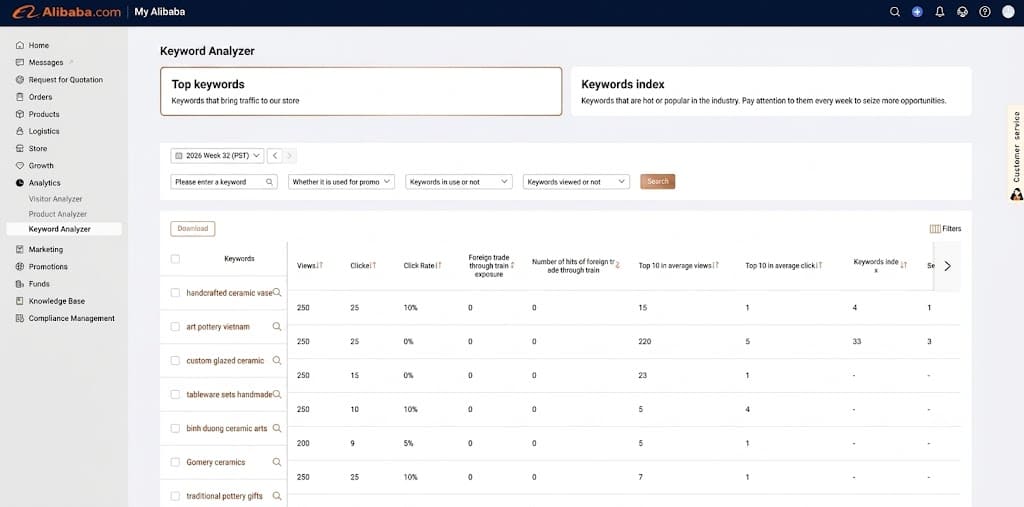
Alibaba’s search algorithm heavily weighs title and attribute keywords, but I’ve seen too many sellers over-optimize and end up with listings that read like keyword soup. The trick is blending SEO with natural, buyer-friendly language.
I start by pulling keyword data from Alibaba’s own search suggestions — type your product name and see what auto-fills. Those are real buyer search terms. I also check competitor listings ranking on page one for the same product, noting which phrases repeat across multiple top listings.
Then I map these keywords into different listing sections rather than cramming them all into the title:
- Title: 2-3 highest-volume keywords.
- Attributes/specifications: Technical keywords like material type, size range, certification.
- Description body: Long-tail variations and use-case phrases.
For Gomery Ceramics, we ranked well for “custom ceramic mug wholesale” not because we repeated it ten times, but because it appeared naturally across title, attributes, and the first line of description — that consistency signals relevance to the algorithm without tripping spam filters.
Highlighting Customization, MOQ, and Certifications Clearly
Buyers almost always ask about customization, MOQ, and certifications, so answering these upfront in a dedicated “quick facts” block reduces time-wasting chat questions. On TP-Menswear listings, adding this block noticeably improved inquiry quality — more buyers arrived already ready to negotiate quantities and pricing.
International buyers sourcing on Alibaba almost always ask about three things eventually: can you customize, what’s your minimum order quantity, and do you have relevant certifications. Smart sellers answer these upfront instead of waiting for chat questions.
I dedicate a specific section near the top of the description for this — I call it the “quick facts” block. It’s short, bullet-based, and impossible to miss:
- MOQ: State exact numbers, and if flexible, say so (“500 pcs, negotiable for trial orders”).
- Customization: Logo printing, color options, packaging branding — list everything available.
- Certifications: FDA, ISO, BSCI, whatever applies — buyers filter by these constantly.
- Lead time: Give a realistic range, not just “fast delivery.”
When I applied this to TP-Menswear listings, we noticed inquiry quality improved — fewer time-wasting questions, more buyers who already knew our terms and were ready to negotiate quantities and pricing. That’s the real win: attracting buyers isn’t just about volume of inquiries, it’s about attracting the *right* ones who convert into actual orders.
Bringing It All Together
Knowing how to write an Alibaba product listing comes down to clear structure, honest visuals, smart keyword placement, and upfront answers to buyer questions. If you want the bigger picture on running a successful Alibaba storefront beyond just listings, check out our complete guide: [INTERNAL LINK: Alibaba selling strategy pillar guide].
Ready to turn your listings into a lead-generating machine?
Need professional Alibaba storefront management? Big E Co. offers end-to-end services. Learn more →
Bạn muốn đồng hành cùng Hồ Alva?
Gia nhập cộng đồng Saigon Ladyboss — nơi những người phụ nữ bản lĩnh cùng nhau học và lớn lên.
Gia nhập Saigon Ladyboss →