I’ve spent 5 years living inside Alibaba, Etsy, and Amazon dashboards, and one question I still get almost weekly from clients is: “Ho, should I use Alibaba, AliExpress, or Made-in-China?” So day la bai viet ve Alibaba vs AliExpress vs Made-in-China danh cho SME Viet Nam dang can nhap hang de ban qua Alibaba, Etsy hoac Amazon — giup ban chon dung san dua tren MOQ, ngan sach va muc do kiem soat chat luong ban can. When I was scaling Gomery Ceramics out of Binh Duong, I actually tested all three platforms for different sourcing needs. The Alibaba vs AliExpress vs Made-in-China key differences aren’t just about price — they’re about business model, minimum order quantities, and how much control you have over quality. Let me break it down the way I wish someone had explained it to me back when I was sourcing my first batch of menswear fabric for TP-Menswear.
Alibaba vs AliExpress vs Made-in-China Key Differences: The Quick Overview
Alibaba vs AliExpress vs Made-in-China khac nhau chu yeu o mo hinh kinh doanh: Alibaba va Made-in-China la B2B (business-to-business, ban si theo lo lon), con AliExpress la B2C (business-to-consumer, ban le tung don). Neu ban nham lan ca ba, ban se hoac tra gia le cho don nho, hoac bi ket voi MOQ (so luong dat hang toi thieu) vuot kha nang tai chinh.
I’ve placed orders on all three — from ceramic glaze samples to full container loads of menswear textiles. The differences show up fast once you start requesting quotes.
Comparison Table: Alibaba vs AliExpress vs Made-in-China
Bang duoi day tom tat nhanh 9 tieu chi khac biet chinh giua ba san, ban co the doc doc lap ma khong can xem het bai.
| Criteria | Alibaba | AliExpress | Made-in-China |
|---|---|---|---|
| Business Model | B2B wholesale, bulk orders | B2C retail, single/small unit orders | B2B wholesale, similar to Alibaba |
| Minimum Order Quantity (MOQ) | Usually 50-500+ units, negotiable | Often 1 unit (no MOQ) | Usually 50-500+ units, negotiable |
| Typical Buyer | Wholesalers, importers, brand owners | Dropshippers, individual consumers | Wholesalers, importers, industrial buyers |
| Pricing | Lower per-unit cost at volume | Higher per-unit, retail markup included | Similar to Alibaba, sometimes more negotiable |
| Supplier Verification | Gold Supplier, Verified/Assessed badges, trade assurance | Seller ratings, limited factory verification | Verified Supplier badges, on-site audits available |
| Payment Protection | Trade Assurance escrow | Buyer protection, refund guarantee | Trade Assurance-style escrow (less robust) |
| Shipping Speed | Weeks (sea/air freight for bulk) | Days to 2 weeks (small parcel post) | Weeks (similar to Alibaba) |
| Product Range | Massive, factory-direct | Massive, consumer-facing listings | Strong in industrial, hardware, machinery |
| Negotiation Culture | Expected, heavy price/MOQ negotiation | Rarely negotiated | Expected, similar to Alibaba |
| Best For | Wholesale importing, private label | Dropshipping, small test orders | Industrial goods, alternative supplier pool |
Alibaba: The Wholesale Powerhouse
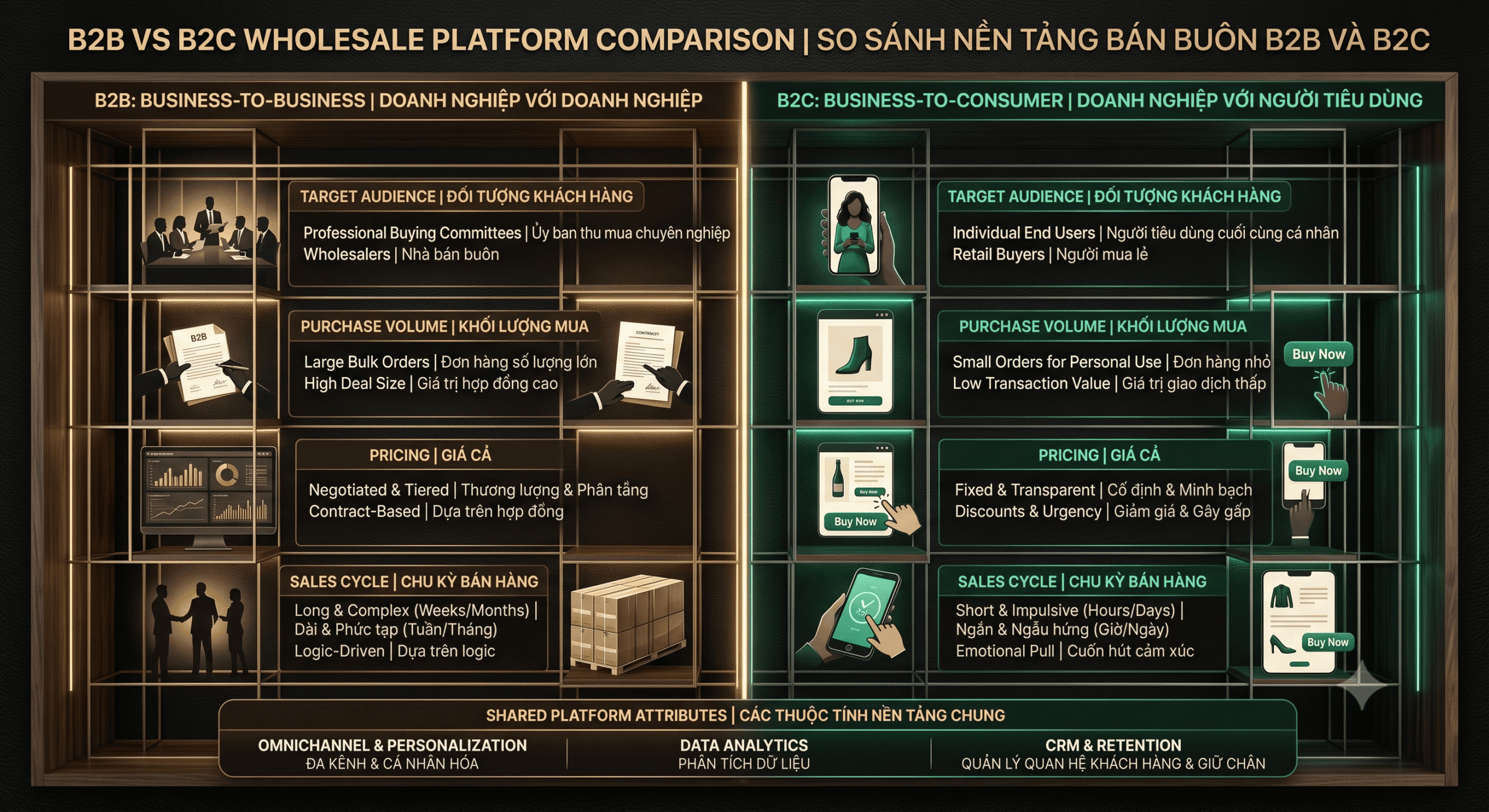
Alibaba phu hop nhat voi nguoi ban muon xay dung brand rieng va can MOQ tu 50-100 don vi tro len de duoc gia san xuat that. Day la san toi khuyen dung dau tien cho chu doanh nghiep nghiem tuc vi co Trade Assurance (bao ve giao dich escrow) va he thong nha may verified.
Alibaba is where I source most of my bulk orders, and it’s honestly the platform I recommend first to serious business owners. When I was building TP-Menswear’s fabric supply chain, Alibaba gave me access to verified factories in Guangzhou and Hangzhou that could actually customize fabric weight, color, and packaging at scale.
The trade-off is MOQ. Most suppliers won’t entertain orders under 50-100 units unless you’re buying samples first. But you get real factory relationships, Trade Assurance protection, and the ability to build a long-term supplier partnership — something that matters a lot once you’re running a brand, not just flipping products.
When Alibaba Makes Sense
- You’re launching a private label product and need custom branding or packaging
- You want to build a recurring supplier relationship for repeat orders
- You’re importing container-scale quantities for Amazon FBA or retail
- You need factory-level pricing and are ready to negotiate
AliExpress: The Retail-Friendly Option
AliExpress phu hop nhat khi ban can test san pham voi so luong 1 don vi, khong bi rang buoc MOQ nhu Alibaba. Doi lai, gia mua se gan muc ban le va kha nang tuy chinh san pham gan nhu khong co.
AliExpress is a completely different animal. There’s no MOQ pressure — you can literally order one item to test it. I used AliExpress early on when I wanted to sample small ceramic accessories before committing to a full Gomery Ceramics production run.
The downside is pricing. You’re paying closer to retail, and customization options are limited because you’re buying from existing inventory, not commissioning a production run. It’s also harder to verify if the “supplier” is actually a factory or just a reseller.
When AliExpress Makes Sense
- You’re dropshipping and need to fulfill single-unit orders directly to customers
- You want to test a product’s market demand before committing to bulk MOQ
- You need fast, small-quantity samples without formal supplier negotiation
- You’re a hobbyist or small seller not ready for wholesale volume
Not sure which platform fits your sourcing strategy?
Need professional Alibaba storefront management? Big E Co. offers end-to-end services. Learn more →
Made-in-China: The Underrated Alternative
Made-in-China la lua chon phu tot cho nguoi mua hang cong nghiep, may moc, phu tung ky thuat — nhung nganh hang khong duoc Alibaba phu song day dac. Diem manh cua san nay la nha cung cap thuong san sang thuong luong gia hon vi it bi dropshipper canh tranh.
Made-in-China doesn’t get as much attention as Alibaba, but I’ve used it specifically when sourcing industrial equipment and hardware components for packaging machinery at Gomery Ceramics. It operates on a similar B2B model to Alibaba but tends to have a stronger presence in industrial, mechanical, and hardware categories.
What I like about Made-in-China is that suppliers there are often more willing to negotiate on price, and I’ve found some factories listed there that weren’t even on Alibaba. It’s a solid second source to cross-check pricing and expand your supplier pool, especially if you’re in manufacturing or B2B equipment sourcing.
When Made-in-China Makes Sense
- You’re sourcing industrial machinery, hardware, or technical equipment
- You want a secondary supplier pool to compare quotes against Alibaba
- You need suppliers less saturated by dropshippers and small buyers
- You’re doing due diligence and want to cross-verify a factory’s legitimacy
Quality Control and Supplier Verification Differences
Alibaba va Made-in-China dung he thong badge xac minh (Verified/Gold Supplier) dua tren giay phep kinh doanh va audit nha may, trong khi AliExpress chu yeu dua vao danh gia khach hang vi day la san consumer-facing (huong den nguoi tieu dung ca nhan). Du chon san nao, ban van can kiem hang doc lap (third-party inspection) truoc khi thanh toan cuoi cung.
This is where I’ve seen the most confusion among first-time importers. On Alibaba, “Verified Supplier” and “Gold Supplier” badges mean the platform has done some level of business license and factory audit checks — but you still need third-party inspection for real quality assurance.
AliExpress relies more heavily on customer reviews and seller ratings since it’s consumer-facing, which makes it weaker for verifying actual manufacturing capability. Made-in-China offers similar verification tiers to Alibaba, including onsite audit reports, but the review ecosystem is smaller, so you’ll do more manual vetting yourself.
Regardless of platform, I always recommend a third-party inspection service before final payment on any bulk order. I learned this lesson the hard way with an early ceramics shipment where photos looked perfect but the actual glaze finish was inconsistent across the batch.
[INTERNAL LINK: how to verify Alibaba suppliers before placing bulk orders]
Shipping, Logistics, and Cost Structure
Alibaba va Made-in-China thuong van chuyen bang duong bien hoac hang khong cho lo hang lon, mat 2-6 tuan tuy diem xuat phat va dich. AliExpress giao hang nho qua ePacket, chi mat 1-3 tuan nhung khong the scale khi don hang vuot vai tram don vi/thang.
Alibaba and Made-in-China both typically ship via sea or air freight for bulk orders, meaning you’re looking at 2-6 weeks depending on origin and destination. You’ll also need to handle customs clearance, import duties, and freight forwarding — which is a whole additional layer of logistics planning.
AliExpress ships small parcels, often through ePacket or similar services, arriving in 1-3 weeks with duties usually simplified or bundled. This makes it far easier for beginners, but it’s not scalable once your order volume grows beyond a few hundred units a month.
[INTERNAL LINK: Alibaba shipping and freight forwarding guide for first-time importers]
Which Platform Should You Actually Use?
Chon Alibaba neu xay brand va nhap container; chon AliExpress neu dropship hoac test san pham; chon Made-in-China neu can nguon hang cong nghiep hoac muon benchmark gia so voi Alibaba.
Here’s my honest, practical recommendation based on real sourcing scenarios:
- Choose Alibaba if you’re building a brand, need custom packaging, or plan to import container-level quantities regularly
- Choose AliExpress if you’re dropshipping, testing a new product idea, or need small quantities without commitment
- Choose Made-in-China if you’re sourcing industrial/technical products or want a secondary quote source to negotiate better Alibaba pricing
In practice, I often use two platforms simultaneously — Alibaba for my main supplier relationship and Made-in-China to benchmark pricing and find backup suppliers in case of delays. That flexibility has saved both Gomery Ceramics and TP-Menswear from single-supplier dependency more than once.
Final Thoughts
Understanding the Alibaba vs AliExpress vs Made-in-China key differences comes down to matching the platform to your business stage. Beginners testing products should start with AliExpress. Serious importers building a brand need Alibaba’s wholesale infrastructure and Trade Assurance protection. And anyone in industrial or technical goods should keep Made-in-China in their sourcing toolkit as a smart backup.
Nam ro Alibaba vs AliExpress vs Made-in-China giup ban chon dung san ngay tu dau, tranh mat thoi gian va chi phi thu-sai khi nhap hang xuat khau.
Ready to build a reliable Alibaba sourcing strategy?
Need professional Alibaba storefront management? Big E Co. offers end-to-end services. Learn more →
Bạn muốn đồng hành cùng Hồ Alva?
Gia nhập cộng đồng Saigon Ladyboss — nơi những người phụ nữ bản lĩnh cùng nhau học và lớn lên.
Gia nhập Saigon Ladyboss →