

Five years running Alibaba, Etsy, and Amazon stores has taught me one expensive lesson: the sea freight vs air freight for exporting from Vietnam decision can make or break your margins. I’ve shipped ceramic vases from Gomery Ceramics in Binh Duong that cracked because I chose the wrong carrier speed, and I’ve also blown an entire quarter’s profit on rush air freight for TP-Menswear when a buyer changed order dates last minute. Let me walk you through what I’ve actually learned, not just textbook theory.
Sea Freight Vs Air Freight For Exporting From Vietnam: The Basics
Sea freight moves cargo by container ship and costs far less per kilogram, but takes 25-40 days to reach the US. Air freight moves cargo by plane, costs 4-12 times more, but arrives in 3-7 days — the right choice depends on your product weight, margin, and deadline.
When you’re exporting from Vietnam, you’re really choosing between two very different games. Sea freight is the slow, steady, budget-friendly workhorse — think weeks, not days. Air freight is the fast, expensive option you reach for when time matters more than cost.
I remember my first year handling Gomery Ceramics’ exports. I defaulted to sea freight because “that’s what everyone does” for heavy goods. It worked, but I didn’t understand WHY until I’d made a few costly mistakes with lead times and buyer expectations. Understanding the real differences changed how I quote shipping to clients today.
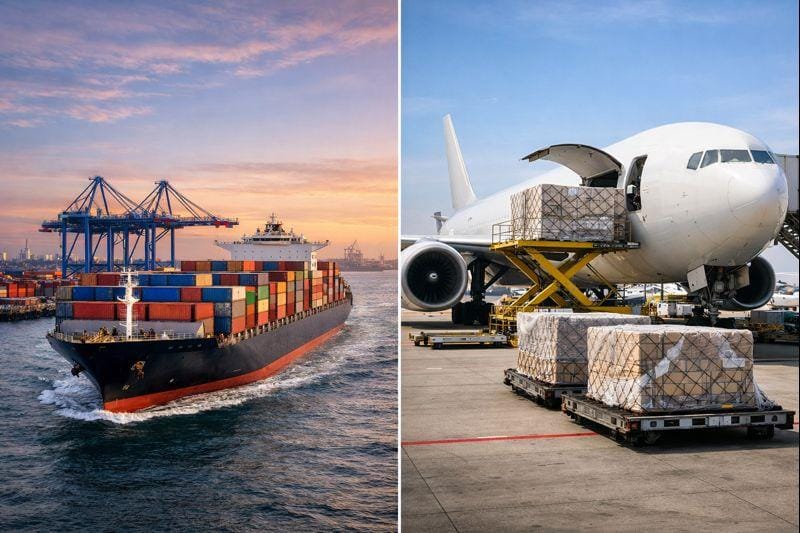
Comparing By Cost
Sea freight typically costs $0.10-$0.40 per kg while air freight runs $3-$6 per kg on the Vietnam-to-US route — a gap of 4 to 12 times depending on season and route. For bulky, low-value goods like apparel, air freight is rarely realistic outside of small sample shipments.
Cost is usually the first question every seller asks me. Here’s the honest truth: sea freight can be 4 to 12 times cheaper than air freight per kilogram, depending on the route and season.
For TP-Menswear, shipping a 500kg batch of shirts from Ho Chi Minh City to Los Angeles by sea typically cost us around $0.15–$0.30 per kg (all-in with LCL rates), while the same shipment by air ran $3.50–$5.00 per kg. That’s not a small gap — for bulky, low-value items like clothing, air freight often isn’t even a realistic option unless it’s a tiny sample shipment.
With Gomery Ceramics, though, the calculation gets trickier. Ceramics are heavy and take up volume, so even sea freight costs add up fast because pricing is based on chargeable weight (whichever is higher between actual weight and volumetric weight — the greater of a shipment’s actual scale weight versus its size-based equivalent weight).

Comparing By Speed And Lead Time
Air freight from Vietnam to the US West Coast takes 3-7 days door to door, while sea freight takes 25-40 days depending on port congestion and transshipment routing. If your buyer needs stock in under two weeks, sea freight is not an option.
This is where air freight earns its premium. A shipment from Hanoi or Ho Chi Minh City to the US West Coast by air takes roughly 3–7 days door to door. The same route by sea? Anywhere from 25 to 40 days, sometimes longer if there’s port congestion or you’re routing through transshipment hubs like Singapore or Hong Kong.
I once had a TP-Menswear buyer in Germany place a reorder just three weeks before a trade show. Sea freight would have missed the event completely. We ate the cost difference and air-shipped 200kg of samples and initial stock. It wasn’t cheap, but it saved the relationship and led to a much bigger PO afterward.
Comparing By Cargo Type And Weight Suitability
Heavy, bulky, low-value goods like furniture and ceramics generally ship cheaper by sea, while high-value, lightweight, or time-sensitive goods like electronics and fashion samples suit air freight better. Matching cargo type to shipping method is the single biggest cost-saving decision new exporters get wrong.
Not every product suits every shipping method, and this is something new exporters often get wrong. Heavy, bulky, low-value goods (furniture, ceramics, home decor) almost always make more sense by sea. High-value, lightweight, or time-sensitive goods (electronics, fashion samples, urgent restocks) are better candidates for air.
Gomery Ceramics is a perfect case study. Our vases and pottery pieces are heavy relative to their value, so air freight costs would eat up any profit margin almost instantly. We reserve air freight only for urgent sample shipments to new buyers who need to see quality before committing to a bulk sea order.
Comparing By Risk And Damage Control
Sea freight involves more handling touchpoints — loading, transshipment, unloading — which raises breakage risk for fragile cargo like ceramics. Air freight has fewer handling stages and shorter exposure time, making it the safer option for fragile or high-value goods.
This one surprised me early on. You’d think longer transit times mean more risk, but it’s actually more about handling frequency and cargo type. Ceramics on long sea voyages face more handling touchpoints — loading, transshipment, unloading — which increases breakage risk if packaging isn’t rock solid.
After losing about 8% of one Gomery Ceramics shipment to breakage on a sea route through a rough transshipment port, I upgraded our packaging standards significantly and now reserve air freight for any first-time buyer sample orders regardless of cost.
Comparing By Flexibility And MOQ Requirements
Sea freight requires thinking in container terms — full container load (FCL) or less than container load (LCL) — which favors larger order volumes. Air freight is more flexible for small quantities and can even be cheaper than sea for shipments under 50kg.
Sea freight typically requires you to think in terms of container space — either full container load (FCL) or less than container load (LCL). This means you often need meaningful order volume to make the shipping cost-efficient. Air freight, by contrast, is far more flexible for small quantities.
For TP-Menswear, we regularly use air freight for orders under 50kg because LCL sea freight minimum charges sometimes make air the more economical choice for very small shipments. It’s counterintuitive, but at low weights, the cost gap between sea and air narrows considerably.
Still unsure which shipping method fits your product line?
Need professional Alibaba storefront management? Big E Co. offers end-to-end services. Learn more →
Comparing By Documentation And Customs Complexity
Air freight customs clearance typically takes 24-48 hours, while sea freight clearance can take several days, especially during peak season at busy ports. Both methods require a commercial invoice, packing list, and certificate of origin, but the transport document differs: bill of lading for sea, air waybill for air.
Both methods require similar core paperwork — commercial invoice, packing list, bill of lading (sea) or air waybill (air), and certificate of origin if you’re using preferential tariffs. But in my experience, air freight customs clearance moves faster, often within 24–48 hours, while sea freight customs can take several days, especially during peak season congestion at ports like Cat Lai.
Getting these documents right the first time avoids costly delays at ports like Cat Lai. For a deeper walkthrough of Vietnam’s shipping ecosystem and support options, visit our Ho Alva homepage.
Full Comparison Table
The table below summarizes the core trade-offs between sea and air freight for Vietnam exporters, covering cost, speed, cargo fit, and risk in one view.
| Criteria | Sea Freight | Air Freight |
|---|---|---|
| Cost per kg | Low ($0.10–$0.40/kg typical) | High ($3–$6/kg typical) |
| Transit time (Vietnam to US) | 25–40 days | 3–7 days |
| Best for cargo type | Heavy, bulky, low-value goods | Lightweight, high-value, urgent goods |
| Minimum order flexibility | Better for large volumes (FCL/LCL) | Better for small quantities |
| Damage/handling risk | Higher (more touchpoints, longer exposure) | Lower (fewer handling stages) |
| Customs clearance speed | Slower, especially peak season | Faster, usually 24–48 hours |
| Environmental impact | Lower carbon footprint per unit | Higher carbon footprint per unit |
| Ideal use case | Bulk restocks, ceramics, furniture, seasonal inventory | Samples, urgent reorders, trade show deadlines, high-value electronics |
When To Use Sea Freight
Use sea freight when your product is heavy, margins are thin, and you have at least 4-6 weeks of lead time to plan around. This is the default for most Gomery Ceramics bulk orders where volume justifies container costs.
- Bulk restocking with predictable demand
- Heavy or bulky products like ceramics, furniture, home goods
- Buyers with flexible delivery timelines
- Cost-sensitive categories with thin margins
When To Use Air Freight
Use air freight when speed matters more than cost, when shipping samples to close a deal, or when a product’s value per kg justifies the premium. TP-Menswear relies on this for urgent European reorders and trade show prep.
- New buyer sample shipments to secure trust
- Time-sensitive events like trade shows or seasonal launches
- Small quantity orders under LCL minimums
- High-value, low-weight products
My Honest Recommendation By Use Case
If you’re running a ceramics or home goods business, default to sea freight for around 90% of shipments and reserve air only for samples or emergency restocks. If you’re in fashion, run a hybrid strategy — sea for bulk seasonal stock, air for reorders and time-sensitive markets. If you want tailored help mapping this to your own product line, our Alibaba storefront management services walk through it case by case.
There’s no universal winner in the sea freight vs air freight for exporting from Vietnam debate. It genuinely depends on your product weight, margin structure, and how much your buyer values speed over price. I’ve made both mistakes — shipping too slow and losing a deal, and shipping too fast and losing my margin — so plan realistically rather than defaulting out of habit.
Want help building an export strategy that balances cost and speed?
Need professional Alibaba storefront management? Big E Co. offers end-to-end services. Learn more →
Bạn muốn đồng hành cùng Hồ Alva?
Gia nhập cộng đồng Saigon Ladyboss — nơi những người phụ nữ bản lĩnh cùng nhau học và lớn lên.
Gia nhập Saigon Ladyboss →